The Largest Evacuation Challenge in India’s History
As Iranian missiles and drones rain down on Gulf Cooperation Council (GCC) states, the Indian government faces a crisis of unprecedented scale: the safety and potential evacuation of approximately 10 million Indian nationals living and working across the Middle East. This dwarfs every previous evacuation operation in Indian history — including the 1990 Kuwait airlift (170,000 people), the 2006 Lebanon evacuation, and the 2015 Yemen rescue.
An estimated 4.3 million Indians reside in the UAE alone, constituting approximately 35% of the country’s total population, with over half concentrated in Dubai. Across Saudi Arabia, Qatar, Kuwait, Bahrain, and Oman, millions more work in construction, hospitality, healthcare, technology, and domestic services — forming the backbone of Gulf economies.
MEA Control Room, Helplines, and Emergency Flights
The Ministry of External Affairs (MEA) has established a 24/7 crisis control room with dedicated helpline numbers, coordinating with Indian missions across all six GCC nations. Advisories have been issued to Indian nationals in the UAE, Kuwait, Jordan, and Saudi Arabia urging “utmost caution, avoidance of unnecessary travel, vigilance, and adherence to local safety guidelines.”
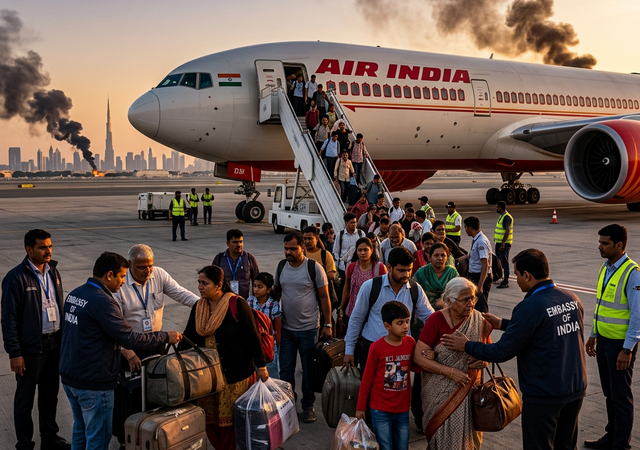
Special relief and evacuation flights are already operational. Air India, IndiGo, and Air India Express are operating emergency flights from Jeddah, Dubai, Abu Dhabi, Doha, and Kuwait City to bring stranded nationals home. India has also relocated its students from Tehran to safer areas within Iran as a precautionary measure. At least one Indian national has been confirmed injured in the UAE.
The ₹12.5 Lakh Crore Remittance Lifeline at Risk
Beyond the humanitarian crisis, the conflict threatens a critical pillar of India’s economy: overseas remittances. In FY2024-25, India received approximately ₹12.53 lakh crore ($135.46 billion) in remittances — the highest of any nation globally. A staggering 38% of this — over ₹4.7 lakh crore — originates from the Gulf region.
If the conflict forces mass evacuations or prolonged unemployment of Indian workers in the Gulf, the impact on millions of families dependent on these remittances in states like Kerala, Bihar, Uttar Pradesh, Rajasthan, and Andhra Pradesh would be devastating. Entire local economies in these states are sustained by Gulf remittance flows. A sudden stop could trigger a domestic social and economic crisis, particularly in rural and semi-urban India.
The Indian government has declared that the safety and well-being of its Gulf diaspora is of “utmost priority” — but the logistical challenge of evacuating even a fraction of 10 million people from an active war zone remains staggeringly complex.
Disclaimer: This article is for informational purposes only and does not constitute investment advice, a recommendation, or a solicitation to buy or sell any securities. The views expressed are those of the author and do not represent the official position of Benzinga India. Readers should consult a SEBI-registered financial advisor before making any investment decisions. Benzinga India and its authors do not hold any positions in the securities mentioned in this article unless explicitly stated.