From Budget Allocation to Battlefield Reality
India’s defense budget for FY2026-27 stands at a record ₹7.85 lakh crore ($94.3 billion) — a 15% increase from the previous year, with capital expenditure for new equipment rising 22% to ₹2.19 lakh crore. The US-Iran war is now providing the most severe real-world stress test of India’s military preparedness and strategic planning in decades.
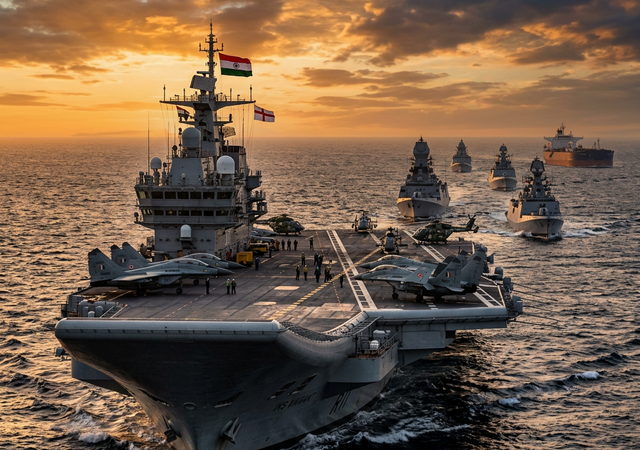
The conflict has immediately elevated two priorities: protecting India’s energy supply lines through the Arabian Sea and Indian Ocean, and ensuring the security of India’s maritime borders amid heightened regional instability. The Indian Navy has reportedly deployed additional assets — including the aircraft carrier INS Vikrant and destroyers — in the Arabian Sea to patrol critical shipping lanes.
Key Military Assets and Strategic Acquisitions
India’s recent defense modernization push means it enters this crisis significantly better equipped than a decade ago:
- S-400 Air Defense: India has cleared the procurement of five additional S-400 Triumf missile defense systems from Russia, bringing the total to ten. This advanced system provides multi-layered air defense against ballistic missiles and aircraft — critical if the conflict spills beyond the Gulf.
- Naval Expansion: Four Project 17A stealth frigates, the nuclear submarine INS Aridaman, and the carrier INS Vikrant significantly enhance India’s blue-water naval capability and ability to project power across the Indian Ocean Region.
- TEJAS MK-1A: The indigenous light combat aircraft is entering service, reducing reliance on imported platforms and bolstering the “Atmanirbhar Bharat” (self-reliant India) defense initiative. 75% of the capital defense budget is now earmarked for domestic procurement.
- Exercise Agni Varsha & Vayushakti 2026: The Indian Army and Air Force recently conducted major exercises validating integrated combat capabilities, precision strikes, and tactical dominance — lessons drawn directly from the Russia-Ukraine war.
The Broader Strategic Calculus: IMEC, Chabahar, and the Indian Ocean
The Gulf crisis has injected urgency into India’s long-term strategic calculus. The India-Middle East-Europe Economic Corridor (IMEC) is in jeopardy, the Chabahar Port’s future is uncertain, and the entire Indian Ocean Region faces heightened instability.
Military analysts argue that India must now accelerate three critical capabilities:
- Maritime Patrol and Surveillance: Enhanced anti-submarine warfare and surface surveillance to safeguard energy supply lines from potential state and non-state threats.
- Anti-Access/Area Denial (A2/AD): Capabilities to deter and deny hostile forces from threatening India’s maritime interests in the extended neighborhood.
- Logistics and Evacuation Readiness: The ability to mount large-scale civilian evacuations from hostile environments — a capability now being tested in real-time by the Gulf crisis.
India’s defense spending trajectory was already upward, but the Gulf war may serve as a watershed moment — forcing the nation to transition from planned modernization to accelerated, crisis-driven capability building. The estimated $543 billion defense spend projected for 2026-2030 may need significant upward revision if the Middle East conflict does not resolve quickly.