The Greatest Test of India’s “Multi-Alignment” Foreign Policy
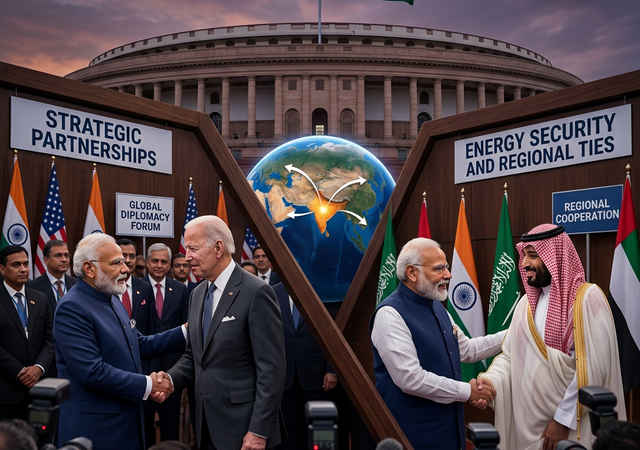
The US-Iran war has placed India in the most precarious diplomatic position of the 21st century. New Delhi must simultaneously manage its comprehensive strategic partnership with the United States, its historical and energy-linked relationship with Iran, deep economic ties with Gulf Arab states, and the safety of approximately 10 million Indian citizens living and working across the Middle East.
India’s Ministry of External Affairs (MEA) has expressed “deep concern” over the escalation, calling for “restraint, dialogue, and diplomacy from all parties.” Notably, India has walked a careful line — condemning Iran’s retaliatory strikes on the UAE (which directly affected Indian nationals) while refraining from explicitly condemning the US-Israeli strikes on Iran. The MEA explicitly denied reports alleging Indian ports were being used for US Navy operations against Iran.
Chabahar Port and IMEC: Strategic Investments Under Threat
India has significant strategic investments in Iran — most critically, the Chabahar Port, which provides India a crucial gateway to Afghanistan and Central Asia that bypasses Pakistan entirely. The port, developed with Indian investment and operational partnership, represents a cornerstone of India’s connectivity strategy in the region.
Equally at risk is the ambitious India-Middle East-Europe Economic Corridor (IMEC), announced at the G20 summit during India’s presidency. This transformative infrastructure project, designed to create a rail and shipping corridor from India through the UAE, Saudi Arabia, Jordan, and Israel to Europe, now faces an existential threat as the very nations it connects are engulfed in conflict.
Modi’s “Telephone Diplomacy” and the Neutrality Debate
Prime Minister Narendra Modi has reportedly engaged in intensive “telephone diplomacy” with leaders in Saudi Arabia, the UAE, Qatar, and Israel, emphasizing the urgent need for regional de-escalation. India’s position echoes its stance during the Russia-Ukraine conflict — maintaining strategic autonomy while engaging with all sides.
However, this balancing act faces intense domestic scrutiny. Critics argue that India’s silence on US-Israeli strikes — while condemning Iranian retaliation — reveals a tilt towards Washington rather than genuine non-alignment. Supporters counter that India’s relationships are “dehyphenated” — each bilateral tie is managed independently based on India’s own national interest, not ideological alignment.
The stakes could not be higher. India’s energy security, its citizen safety, its strategic connectivity projects, and its credibility as a responsible, independent global power all hang in the balance of this catastrophic conflict.