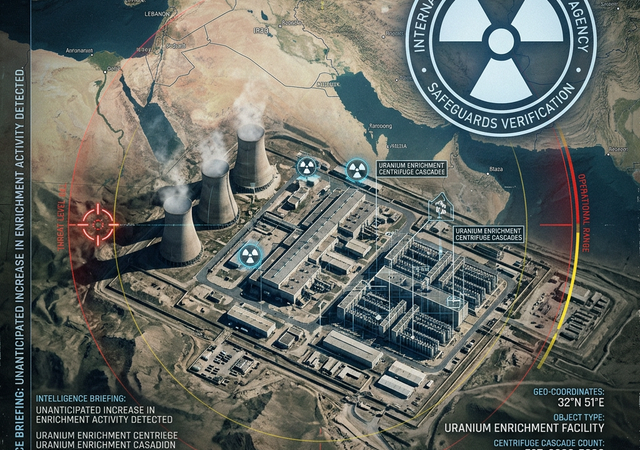
From Enrichment to Existential Threat
The US-Israeli military strikes on Iran were not born from a vacuum. The core trigger behind Operation Epic Fury was Iran’s controversial and rapidly advancing nuclear program. In May 2025, the International Atomic Energy Agency (IAEA) confirmed that Iran had amassed a significant stockpile of 60% enriched uranium — a level dangerously close to the 90% threshold required for weapons-grade material.
To contextualize this: natural uranium contains only 0.7% of the fissile U-235 isotope needed for a nuclear weapon. Achieving 60% enrichment represents a massive technological leap and a clear signal that Iran possesses the capability to produce a nuclear bomb in a matter of weeks, should the political decision be made.
Failed Diplomacy: The Road from Negotiations to Bombs
Throughout 2025, diplomatic efforts to resolve the crisis unfolded in parallel with Iran’s enrichment acceleration. The Trump administration pursued a dual track of “maximum pressure” sanctions and direct negotiations — the first direct US-Iran talks since 2018. Multiple rounds were held in Oman and Rome, with mediators reporting some progress but insurmountable differences on key issues.
The negotiations collapsed definitively on February 26, 2026, when the US demanded a complete end to all uranium enrichment activities. Iran rejected the demand outright, calling it “a violation of national sovereignty.” Just two days later, Operation Epic Fury began.
The Domino Effect: A Middle Eastern Nuclear Arms Race
Beyond the immediate military threat, intelligence agencies have sounded alarms about unchecked nuclear proliferation across the region. If Iran were to successfully develop a viable nuclear weapon, analysts predict that Saudi Arabia, the UAE, and potentially Turkey and Egypt would immediately pursue their own nuclear programs as a deterrent.
Saudi Crown Prince Mohammed bin Salman has publicly stated that if Iran acquires a nuclear device, “the Kingdom will swiftly follow suit.” The specter of multiple nuclear-armed states in the Middle East — a region rife with sectarian tensions, proxy wars, and territorial disputes — represents one of the most dangerous geopolitical scenarios in modern history.