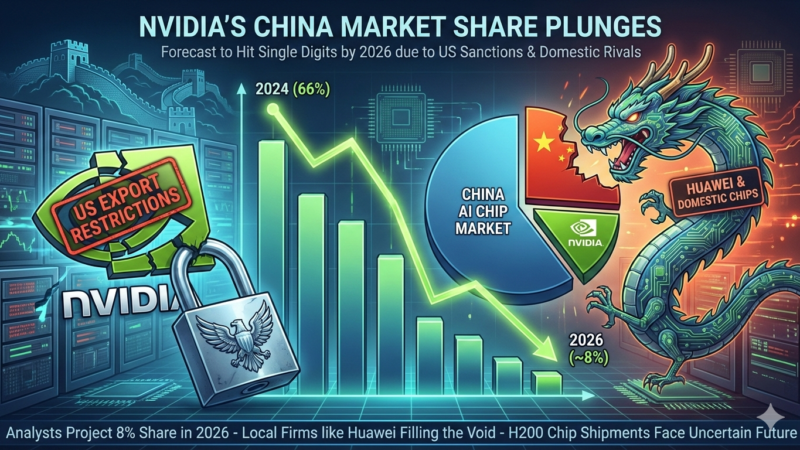
Nvidia China Market Share Falls: 8% in 2026 – Latest News has sent ripples through the global technology industry, signaling a significant shift in the semiconductor landscape. For years, Nvidia has been a dominant force, particularly in the burgeoning Chinese market, fueled by the insatiable demand for its high-performance GPUs essential for artificial intelligence, gaming, and data centers. However, recent reports and projections paint a different picture, suggesting a notable decline in its market share within China by 2026. This development is not just a footnote for investors; it represents a complex interplay of geopolitical tensions, evolving domestic competition, and strategic missteps.
The primary driver behind this projected downturn stems from the escalating U.S.-China trade war and the subsequent restrictions placed on the export of advanced semiconductor technology to China. The U.S. government, citing national security concerns, has implemented stringent export controls, limiting the ability of companies like Nvidia to sell their most sophisticated AI chips to Chinese entities. These chips are crucial for developing advanced AI capabilities, and China has identified them as a strategic priority. Consequently, Nvidia has had to recalibrate its product offerings for the Chinese market, often developing less powerful versions of its chips that comply with export regulations. While this strategy aims to maintain some market presence, it inevitably impacts the company’s competitive edge in areas where cutting-edge performance is paramount.
The Rise of Domestic Competitors in the Semiconductor Arena
Beyond external pressures, the decline in Nvidia’s market share is also a testament to the rapid advancements of Chinese domestic semiconductor manufacturers. Companies like Huawei (through its HiSilicon division), Biren Technology, and Moore Threads have been making significant strides in developing their own AI-accelerating chips. Driven by national investment and a strong desire for technological self-sufficiency, these Chinese firms are increasingly capable of producing GPUs that, while perhaps not yet on par with Nvidia’s absolute top-tier offerings, are becoming increasingly competitive and cost-effective. Furthermore, these domestic players are inherently insulated from U.S. export controls, giving them a distinct advantage in serving the Chinese market. For businesses in China, opting for domestically produced chips can offer greater supply chain stability and avoid the uncertainties associated with international trade disputes. This growing domestic capability directly siphons market share away from established foreign players.
Strategic Implications for Nvidia and the Global Tech Ecosystem
The projected 8% dip in Nvidia’s China market share by 2026, while seemingly a single data point, carries profound strategic implications. China represents a colossal market for semiconductors, and any significant erosion of its presence there will undoubtedly impact Nvidia’s overall revenue and growth trajectory. The company has historically relied on China for a substantial portion of its sales, and this decline necessitates a diversification of its market focus. This could mean doubling down on other key markets like North America, Europe, and India, or exploring new avenues for growth in emerging technologies.
Moreover, the situation highlights the broader trend of technological decoupling. As nations increasingly prioritize indigenous innovation and national security, the global supply chains for critical technologies like semiconductors are undergoing a significant reordering. Companies that can adapt to these shifting geopolitical realities and navigate the complexities of regional market dynamics will be better positioned for long-term success. For Nvidia, this means not only innovating in chip design but also strategically managing its international business operations and relationships.
Navigating the Future: Adaptation and Innovation
For Nvidia, the road ahead in China, and indeed globally, will require a delicate balance of adaptation and continued innovation. The company is actively exploring ways to comply with regulations while still offering compelling solutions. This might involve focusing on its data center offerings that are less affected by current restrictions or investing more heavily in AI software and services that can complement its hardware. Furthermore, fostering stronger partnerships with local Chinese companies that are not directly implicated in the geopolitical tensions could be a viable strategy.
The decline in Nvidia China market share falls: 8% in 2026 – Latest News is not an isolated event but rather a symptom of a larger global technological realignment. It underscores the increasing importance of domestic technological capabilities, the pervasive influence of geopolitical factors on trade, and the constant need for multinational corporations to remain agile and innovative. While Nvidia faces challenges in the Chinese market, its history of innovation and its central role in the AI revolution suggest that it will continue to be a significant player. However, the landscape is undoubtedly changing, and the company’s ability to navigate these shifts will be crucial in determining its future dominance. The semiconductor industry is in a state of flux, and the next few years will be critical in shaping the power dynamics within this vital sector.