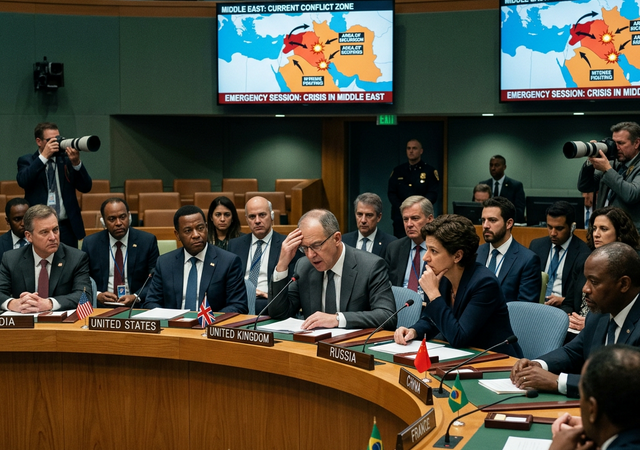
A Council Divided Against Itself
The United Nations Security Council convened an emergency session on February 28, 2026 — the same day Operation Epic Fury’s first strikes hit Tehran. The session immediately exposed the deep fractures running through the international order, with competing narratives from major powers threatening to paralyze any coordinated global response.
France and Colombia formally requested the meeting following the US-Israeli strikes, calling for an immediate ceasefire and the protection of civilian populations. Within hours, China and Russia demanded a separate session, condemning what they termed “the unprovoked and reckless act of military aggression by the United States and Israel.”
The Article 51 Debate: Self-Defense or Aggression?
The United States defended its actions under Article 51 of the UN Charter, which permits the use of force in self-defense. Washington argued that Iran’s advanced nuclear enrichment program, combined with the failure of February 2026 negotiations in Geneva, constituted an “imminent and existential threat” to global security. The US cited Iran’s breach of multiple UN Security Council resolutions regarding its nuclear program as legal justification.
Russia and China rejected this argument entirely, pointing out that Iran was engaged in active, indirect nuclear negotiations in Oman and Geneva when the strikes were launched. China’s ambassador described the operation as “a grave violation of international law and the sovereignty of a UN member state,” while Russia’s representative warned of “catastrophic consequences” if the precedent of preemptive nuclear strikes was normalized.
Pakistan’s Unique Position and NATO’s Dilemma
Pakistan adopted a uniquely balanced stance, condemning both the initial military operation against Iran and Iran’s retaliatory strikes on Gulf countries — reflecting its complex position as a nuclear-armed Muslim nation bordered by Iran, with deep strategic ties to both China and the West.
Meanwhile, NATO and European allies face an excruciating dilemma. A ballistic missile allegedly heading towards Turkish airspace was intercepted by NATO systems, raising the specter of invoking Article 5 — the alliance’s collective defense clause. If Turkey or other NATO members face direct Iranian attack, the alliance could be drawn into a full-scale Middle Eastern war — a scenario no Western government currently desires.